MOVE to SAVE; Join Red Tape Movement at http://www.moving-planet.org/events/in/etawah/428 on 24th Sept. 2011.
Saturday, September 24, 2011


Friday, April 29, 2011
Monday, April 4, 2011
Appreciation from British Embassies
British Embassies of Guatemala City and Ukraine appreciated our work on Earth Hour on 24th March 2011. We are thankful to British Embassies of Guatemala City and Ukraine and their respective respected Ambassadors for the appreciation and also thankful to our savings agents and peoples of Ekdil town area. My special thanks to respected Mr. Vijyendra Pandian, I.A.S., Dr. Rajeev Chauhan, Environmentalist and Mr. Sanjay Saxena, Press Reporter for active participation.
Monday, March 21, 2011
Sunday, March 13, 2011
Earth Hour News: A message from our Global Ambassador Miranda Kerr
Earth Hour News: A message from our Global Ambassador Miranda Kerr: "I am pleased to have been asked to be the global ambassador for Earth Hour 2011. Each of us has a responsibility for the sustainability of..."
Wednesday, March 2, 2011
Saturday, February 19, 2011
The IUCN Forest Conservation Programme Newsletter Issue 42 2010
Read arborvitae newsletter to know that How sexy are forests? Read here.
Friday, February 18, 2011

Tuesday, February 15, 2011

Monday, February 14, 2011

Friday, February 11, 2011
Friday, February 4, 2011

Wednesday, February 2, 2011
World carbon dioxide emissions data
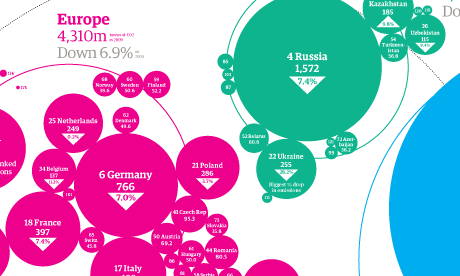
World carbon dioxide emissions are one way of measuring a country's economic growth too.
And the latest figures - published by the respected Energy Information Administration - show CO2 emissions from energy consumption - the vast majority of Carbon Dioxide produced............ Read the complete story HERE.
[Source: guardian]
Tuesday, February 1, 2011
WORLD WETLANDS DAY- 2nd Feb 2011


2 February each year is World Wetlands Day. It marks the date of the adoption of the Convention on Wetlands on 2 February 1971, in the Iranian city of Ramsar on the shores of the Caspian Sea. Each year since 1997, government agencies, non-governmental organizations, and groups of citizens at all levels of the community have taken advantage of the opportunity to undertake actions aimed at raising public awareness of wetland values and benefits in general and the Ramsar Convention in particular.
Wetlands are among the most productive ecosystems in the world, comparable to rain forests and coral reefs; they are found on every continent except Antarctica and from the tundra to the tropics. Due to typical functions like- wildlife habitat and food chain support, groundwater recharge, water purification, nutrient retention and flood control- wetlands are considered as "biological supermarkets", "nurseries of life" and "the kidneys of the landscape" (Barbier et al. 1997; Mitsch and Gosselink 1993). These are facing threats for existence; major threats are- anthropogenic activities, agriculture activities, deforestation, pesticides pollution, pollution, introduced species threats due to Eichhornia etc. Migrating birds use wetlands to rest and feed during their cross-continental journeys and as nesting sites when they are at home. As a result, wetland loss has a serious impact on these species.
The theme for World Wetlands Day 2011 is Wetlands and Forests and slogan is– Forests for water and wetlands. 2011 is a special year for Ramsar as we are celebrating our 40th anniversary. Best Wishes. Read the Message of Mr Anada Tiéga, Secretary General, Ramsar Convention, by clicking here and for Ramsar Sites in Google Earth click here.
[Source: Ramsar and Red Tape Movement]
Friday, January 21, 2011
Long-distance migration may help reduce infectious disease risks for many animal species
It's a common assumption that animal migration, like human travel across the globe, can transport pathogens long distances, in some cases increasing disease risks to humans. West Nile Virus, for example, spread rapidly along the East coast of the U.S., most likely due to the movements of migratory birds. But in a paper just published in the journal Science, researchers in the University of Georgia Odum School of Ecology report that in some cases, animal migrations could actually help reduce the spread and prevalence of disease and may even promote the evolution of less-virulent disease strains. Read detailed report here.
[Source: eurekalert]
[Source: eurekalert]
Expanding Sustainable Timber in Tanzania

There are many negative environmental impacts of globalization — increased pollution, depleted natural resources and an overtaxed food system, to name a few.
The East African blackwood tree (Dalbergia melanoxylon) — known as mpingo in Swahili — may sound exotic to people outside Africa, but chances are you’ve seen it. Its wood is prized for use in musical instruments like clarinets and bagpipes, as well as the traditional sculptures seen in African villages and on Western city streets. However, unregulated logging has seriously depleted much of the tree’s native habitat, posing a threat to the local economy as well as the species that dwell in these forests.
[Source: Conservation International Blog]
The Plant List: a working list of all known plant species
The Plant List is a working list of all known plant species. Version 1, released in December 2010, aims to be comprehensive for species of Vascular plant (flowering plants, conifers, ferns and their allies) and of Bryophytes (mosses and liverworts). It does not include algae or fungi. Version 1 contains 1,244,871 million scientific plant names of which 298,900 are accepted species names. It includes no vernacular or common plant names.
[Source: The Plant List]
Wednesday, January 19, 2011
Species loss tied to ecosystem collapse and recovery
Species loss tied to ecosystem collapse and recovery; Conservation biologists regularly note the precipitous decline of key species, such as cod, bluefin tuna, swordfish and sharks. Lose enough of these top-line predators (among other species), and the fear is that the oceanic web of life may collapse.
[Source: Brown University]
[Source: Brown University]
Saturday, January 15, 2011

Monday, January 3, 2011
Wednesday, November 10, 2010
Drug from evergreen tree kills cancer
The anticancer drug, called maytansine inhibit proliferation of breast cancer cells at mitosis. The Maytansine and its analogues maytansinoids are extraordinarily potent antitumor agents that were originally isolated from members of the higher plant families Celastraceae, Rhamnaceae, and Euphorbiaceae. The maytansinoids, a group of ansa macrocyclic lactams with potent antitumor activity, were first isolated from Maytanus species of family Celastraceae. This reasearch will open the new hope for breast cancer disease treatment.
[Source: science360.gov]
[Source: science360.gov]
Tuesday, November 9, 2010

Tuesday, November 2, 2010
Backyard Wetland
Build a wetland in your backyard. Learn how by visiting the U.S. Department of Agriculture’s web site.
Monday, November 1, 2010
Wetlands and Sarsai Nawar Wetland


![Growers of Water Caltrop [Trapa natans], Singhara, in wetland area, Sarsai Nawar](https://lh3.googleusercontent.com/blogger_img_proxy/AEn0k_vgMhiHKsnh7w0NRRQSrvVFN1_JgEELwNpcd0QUIZd2EnKjaJ0RzjD2TqtlJWAwK-hEl-qwfxXSvm-j9IKzNX9w-1a3fgYkw_vWgKYAX63M_0gSToGj6u8mH55BYR9pHTHV=s0-d)


The Ramsar Convention (Article 1.1) defined wetlands as: “areas of marsh, fen, peat land, or water, whether natural or artificial, permanent or temporary, with water that is static or flowing, fresh, brackish or salt, including areas of marine water the depth of which at low tide doesn’t exceed six meters”. In addition, the convention (Article 2.1) provides that wetlands: “may incorporate riparian and coastal zones adjacent to the wetlands, and islands or bodies of marine water deeper than six meters at low tide lying within the wetlands. Wetlands are among the most productive ecosystems in the world, comparable to rain forests and coral reefs. In wetland ecosystem water is the primary factor controlling both the plant and animal life; they are found on every continent except Antarctica and from the tundra to the tropics . Wetlands fall into four general categories—marshes, swamps, bogs, and fens. Marshes are wetlands dominated by soft-stemmed vegetation, while swamps have mostly woody plants. Bogs are freshwater wetlands, often formed in old glacial lakes, characterized by spongy peat deposits, evergreen trees and shrubs, and a floor covered by a thick carpet of sphagnum moss. Fens are fresh water peat-forming wetlands covered mostly by grasses, sedges, reeds, and wild flowers. Wetlands favours particular type of trees, shrubby species and associated herbs and grasses with algae. Typical characteristic species of wetland ecosystem include hydrophytes such as Cyperus, Azolla, Nymphaea, Typha, Potamogoton, Wolffia, Phragmites, Eichhornia etc., and tree species include species of Ficus, Tamarindus indica, Mimusops, Syzygium, Terminalia, Acacia, Mangifera. An immense variety of species of insects, amphibians, reptiles, birds, fish, and mammals forms fauna of wetlands. Some birds, for example, Plover, Goose, Crane, Flamingo like feed and breeds in wetlands. Detritus Food Chain is the important part of wetland ecosystems. Due to typical functions like- wildlife habitat and food chain support, groundwater recharge, water purification, nutrient retention and flood control- wetlands are considered as "biological supermarkets", "nurseries of life" and "the kidneys of the landscape" (Barbier et al. 1997; Mitsch and Gosselink 1993). India is very rich in wetland habitats; Wetlands in India (excluding rivers), account for 18.4% of the country’s geographic area, of which 70% is under paddy cultivation; there are 21 "Ramsar sites in India".
Under the National Wetlands Conservation Programme (NWCP) programme, 115 wetlands (Annexure I) have been identified till now by the Ministry of Environment(India) and SARSAI NAWAR (area 161.27 ha.) is part of this and is listed at serial number 101. Sarsai Nawar is a vast and beautiful wetland (it is an open form of fen) situated in Takha block of District Etawah. In India, wetlands are disappearing at a rate of 2% to 3% every year and Sarsai Nawar wetland is also facing threats for existence; major threats are- anthropogenic activities, agriculture activities, deforestation, pesticides pollution, rural sewage pollution, introduced species threats due to Eichhornia etc. Trapa and Eichhornia have adverse impact on aquatic ecosystems. Conservation of this wetland is must for the survival of Sarus Cranes (Grus antigone) and many migratory birds as this wetland is the important part of their life and is must for their survival. Migrating birds use wetlands to rest and feed during their cross-continental journeys and as nesting sites when they are at home. As a result, wetland loss has a serious impact on these species.
Also listen about wetlands by just click here.
Wednesday, October 27, 2010

Tuesday, October 26, 2010


Monday, October 25, 2010

Saturday, October 23, 2010
Plants play larger role than thought in cleaning up air pollution

Plants play larger role than thought in cleaning up air pollution . The uptake of oVOC's was especially rapid in dense forests and most evident near the tops of forest canopies, which accounted for as much as 97 percent of the oVOC uptake that was observed. [Source: Eurek Alert, National Science Foundation and Refdoc.fr]
Thursday, October 21, 2010
Friday, October 15, 2010
Water Footprint

 [Fig: Average national water footprint per capita (m3/cap/yr). Green means that the nations's water footprint is equal to or smaller than the global average. Countries with red have a water footprint beyond the global average. Period: 1997-2001]
The water footprint is an indicator of water use and is defined as the total volume of freshwater that is used to produce the goods and services consumed by the individual or community or produced by the business. Human impacts on freshwater systems can ultimately be linked to human consumption. Professor Arjen Y. Hoekstra is the creator of the water footprint concept. he mission of the Water Footprint Network is to promote the transition towards sustainable, fair and efficient use of fresh water resources worldwide. Many countries have significantly externalised their water footprint, importing water-intensive goods from elsewhere. This puts pressure on the water resources in the exporting regions, where too often mechanisms for wise water governance and conservation are lacking. Not only governments acknowledge their role in achieving a better management of water resources, also businesses and public-service organisations increasingly recognize their role in the interplay of actors involved in water use and management. Based on the top-down approach, the global average water footprint is found to be 1240 m3/yr/cap. There are large differences between countries. In the USA the average water footprint is 2500 m3/cap/yr. In China the average water footprint is 700 m3/cap/yr.
So, Save Water, Save Future. Support Blog Action Day 2010 on Water. [Source of image, graph and video: Water Footprint]
Clean Water- A Big Challenge

Since the advent of INDUSTRIAL REVOLUTION, the problem of CLEAN WATER and RELATED PROBLEMS get worsten. Unplanned URBANIZATION-cum-INDUSTRIALIZATION along with POPULATION EXPLOSION resulting into WATER POLLUTION, KILLING OF WATER BODIES, DEATHS OF AQUATIC FLORA and FAUNA, UNINHABITABLE RIVERS, DEATHS OF CHILDREN due to UNSAFE DRINKING WATER etc. Today, nearly ONE BILLION PEOPLE lack basic access to safe water. The problem of UNSAFE WATER is a MAN-MADE PROBLEM; so the solution must be developed by man. SAFE DRINKING WATER is the part of Millennium Development Goal under Target 7C ; the target under MDG 7C is- Halve, by 2015, the proportion of the population without sustainable access to safe drinking water and basic sanitation. On 28 July 2010, UN General Assembly declares access to clean water and sanitation as a human right.
We are facing a big problem of clean water in 21st Century; WE CAN BRING A MAJOR POSITIVE CHANGE by living ENVIRONMENT FRIENDLY LIFE. New Urbanization and Industrialization must fulfill all the parameters of ENVIRONMENT AND WATER BODIES [ underground water, rivers, lakes, wetlands, oceans and glaciers] PROTECTION LAWS and ACTS; old cities and industries must adopt new technologies and infrastructure to treat sewage and pollutants and recycle these; there must be complete ban on release of sewage and industrial influents into water bodies. ENVIRONMENT FRIENDLY LIFESTYLE and FAMILY PLANNING must be made a compulsory fundamental duty for every citizen. Blog Action Day 2010 has announced this year's topic as WATER, at the right time. Clean and Safe water is must for humans and other living beings survival and their right too; OUR FUTURE IS IN CLEAN WATER. Be helpful in achieving MDG target 7C and secure a bright future.
Thursday, October 14, 2010
e-mail From Blog Action Day 2010

Hello Prabhat Misra,
Thanks for joining Blog Action Day! Now that you've registered it's a pretty simple process. All you need to do is put up a post relating to the topic of water on October15th and link to blogactionday.change.org somewhere in your post.
Wednesday, October 13, 2010
Tuesday, October 12, 2010
Campaign to save trees on 10-10-10

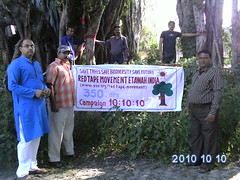
People in Etawah participated in `mission green 10:10:10 campaign' and tied red tapes on tree trunks across the district on Sunday- Times News Network. . Red Tape Movement was started by me in Etawah on 5th June, 2008. Protection of trees and biodiversity conservation are the main activities of this movement. This movement has now crossed border and reaches to Perth, Australia where one Facebook friend Ilona Slany McGavock, a human Doctor, started this with full zeal and enthusiasm on 10-10-10. Thanks to times news network for coverage and all the participants.
Sunday, October 10, 2010
Successful Red Tape Movement- thanks to all


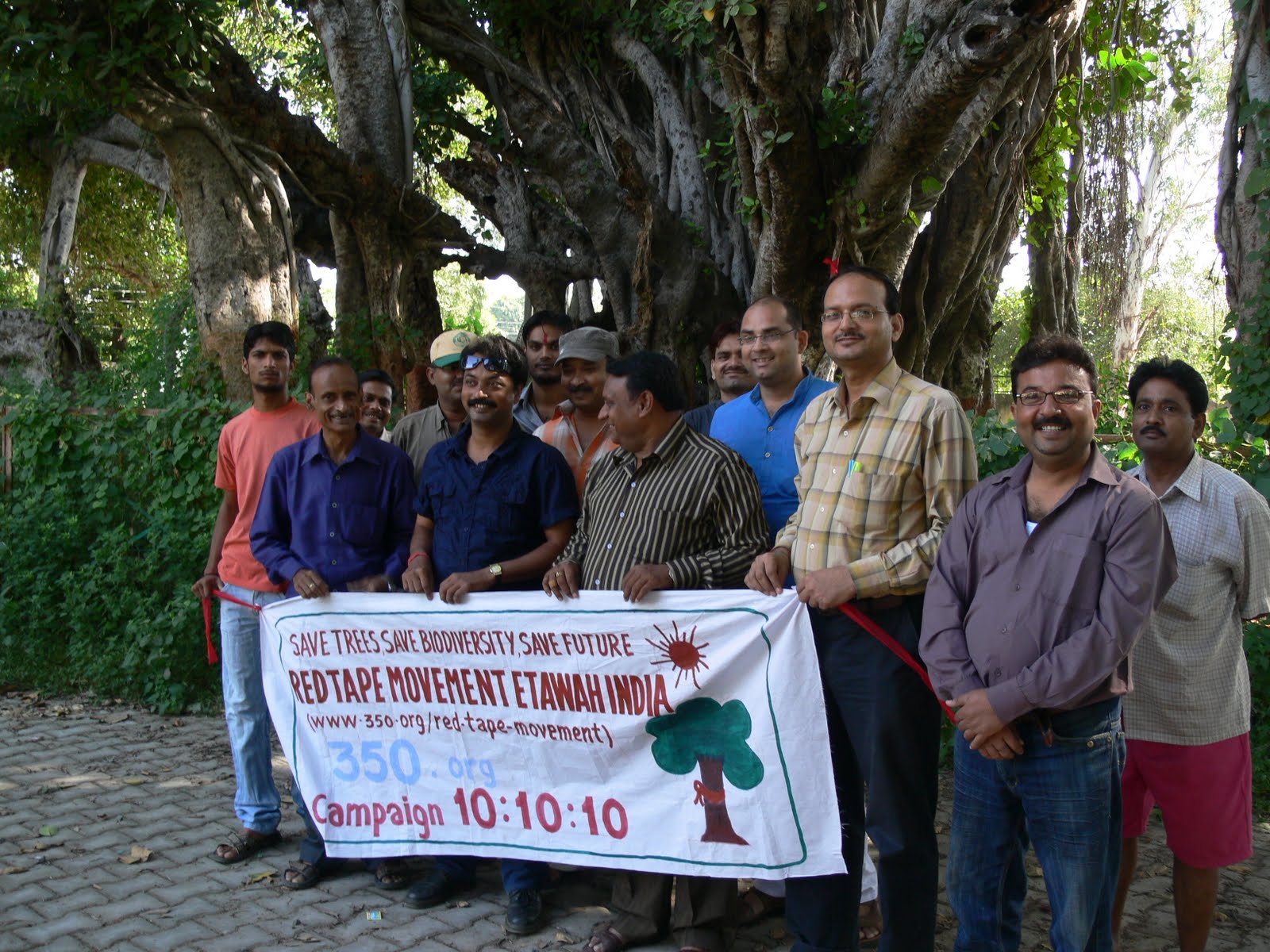
Today, is a great day when whole world is seriously thinking about how to cut carbon emissions by 10% in the year 2010. Today is Global Work Party and 10:10:10 Campaign. I also participated in this through RED TAPE MOVEMENT which was organized at District Hospital Road and in Company Garden in Etawah. Photos of the movement can be seen at Flickr. In Australia the same movement has been organized by Ms. Ilona Slany McGavock; personal thanks and Appreciation to you Ilona and Rosie[ your daughter]. I am thanking to all my Facebook friends who supported my Group and Cause, "Red Tape Movement", as well as to those who supported me on 350.org. I thanks and appreciate to Dr. Rajeev Chauhan [ Secretary General, Society for Conservation of Nature, Etawah ] and Mr. Sanjay Saxena [ President, Swami Vivekanand Sewa Sansthan, Etawah ] for supporting me and making the event successful. I am also thankful to Dr. Ajai Mishra [Vikas Udhyog Samiti], Mr. Vivek Ranjan Gupta, Mr. Nirmal Singh, Mr. Anil Singh, Mr. Vineet Chauhan, Mr. Dharam Pal Chauhan, Mr. Ashutosh Dixit and Md. Altaf for their support. Most important, i am personally thankful to my Chief Guest Mr. Anwar Warsi, District Youth Coordinator, Nehru Yuva Kendra, Etawah. Photos from Australia are on Facebook.
Subscribe to:
Posts (Atom)